Nukekubi
抜け首
Ringkasan
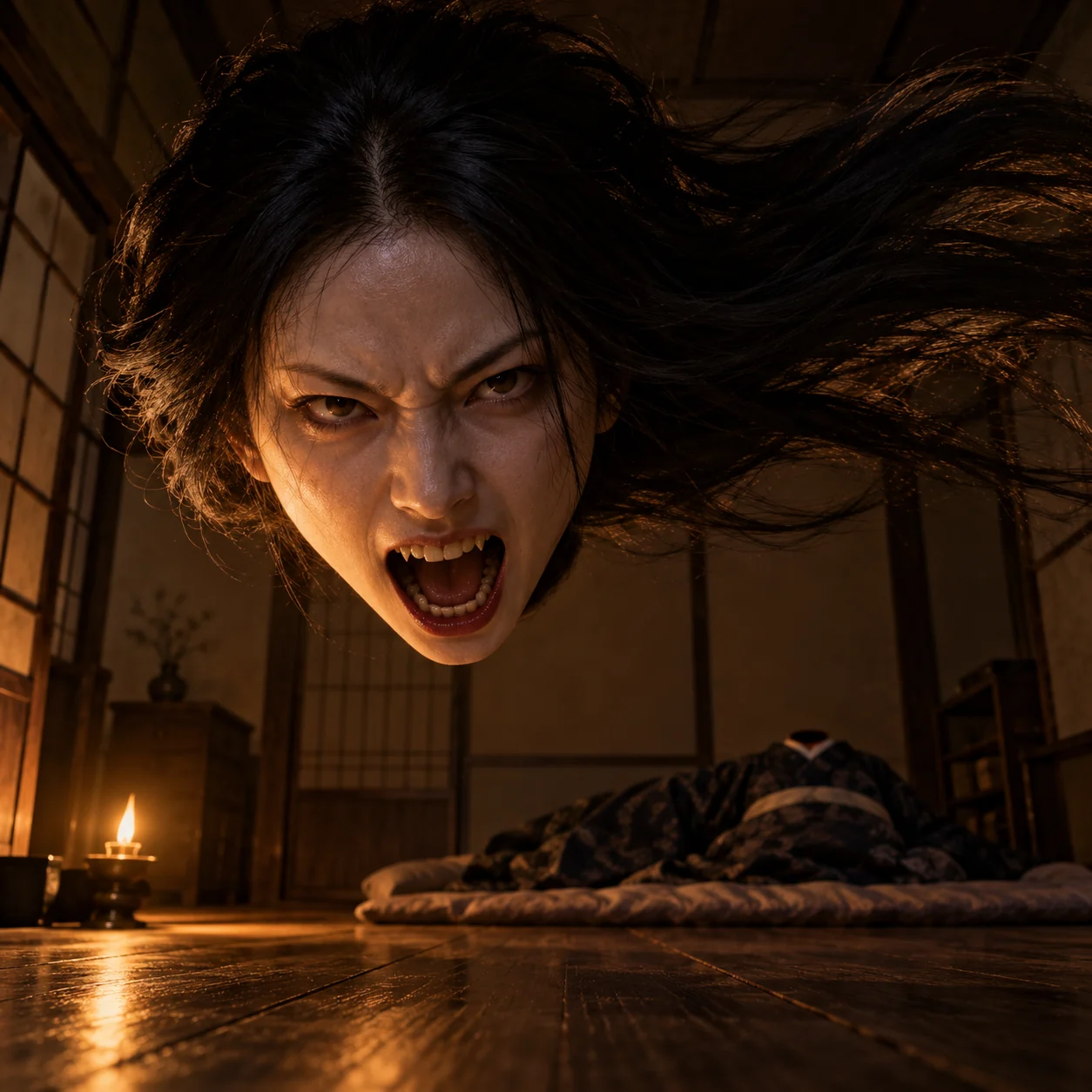
Nukekubi adalah jenis rokurokubi yang kepalanya terlepas sepenuhnya dari tubuh dan dapat terbang; kisah tentangnya populer pada zaman Edo.
Nukekubi is the kind of rokurokubi whose head detaches completely from the body and can fly; tales about it became popular in the Edo period.
Kisah dan tradisi
Nukekubi adalah rokurokubi yang kepalanya terlepas sepenuhnya dari tubuh. Pada rokurokubi, kepala dapat terbang, entah di ujung leher panjang seperti ular atau terlepas sama sekali dari tubuh. Menurut Yokai.com, nukekubi lebih ganas dan haus darah daripada rokurokubi berleher panjang. Kisah dan gambar rokurokubi menjadi sangat populer pada zaman Edo, dan kamus mencatat banyak pustaka zaman Edo yang memuatnya. Lafcadio Hearn memuat kisah "Rokuro-kubi" dalam Kwaidan tentang seorang pendeta yang menginap bersama keluarga makhluk semacam itu. Sebuah kisah zaman Edo bahkan memuat nukekubi lelaki. Pustaka zaman Edo kerap menafsirkan kepala yang terlepas sebagai jiwa yang mengembara keluar tubuh, seperti dalam Sorori Monogatari (1663). Yokai.com menyebut para ilmuwan zaman Edo mengira penderitanya mengidap penyakit mirip berjalan dalam tidur. Diteorikan pula bahwa bila tubuh yang tidur dipindahkan saat kepala melayang, kepala tidak dapat menyatu kembali. Penulis ensiklopedia Jepang menduga kisah kepala terbang berasal dari Tiongkok.
The nukekubi is a rokurokubi whose head detaches completely from the body. In a rokurokubi the head can fly off, either at the end of a long snake-like neck or fully detached from the body. According to Yokai.com, nukekubi are more violent and thirst for blood more than the long-necked rokurokubi. Tales and pictures of rokurokubi became very popular in the Edo period, and a dictionary notes many Edo-period works that record them. Lafcadio Hearn included a story called "Rokuro-kubi" in Kwaidan about a priest who stays with a family of such creatures. An Edo-period tale even includes a male nukekubi. Edo-period works often interpret the detached head as the soul wandering out of the body, as in the Sorori Monogatari (1663). Yokai.com says Edo-period scientists believed sufferers had an affliction like sleepwalking. It is also theorized that if the sleeping body is moved while the head floats, the head cannot rejoin it. The author of a Japanese encyclopedia entry suspects that tales of flying heads came from China.
Fakta utama
- Budaya / Culture
- Folklor & Mitologi Jepang
- Kawasan / Region
- Asia Timur
- Klasifikasi / Classification
- Yokai
- Kemampuan / Abilities
- Kepala terbang
Nama lain / Alternate names
飛頭蛮