Cuca
Ringkasan
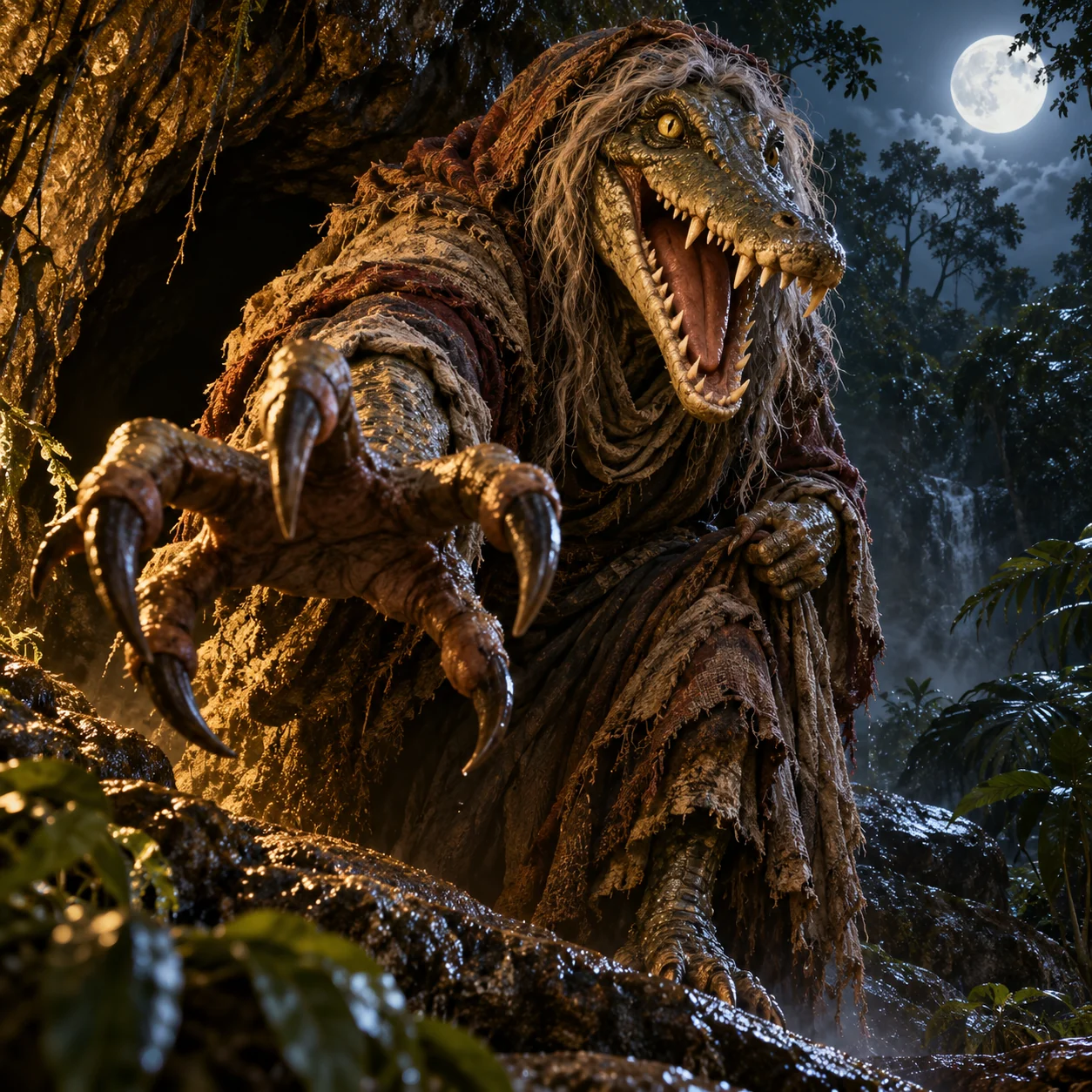
Cuca adalah salah satu makhluk mitologi utama dalam cerita rakyat Brasil: penyihir tua berwajah aligator yang menculik anak-anak.
The Cuca is one of the main mythological beings of Brazilian folklore: an old witch with an alligator appearance who kidnaps children.
Kisah dan tradisi
Cuca adalah salah satu makhluk mitologi utama dalam cerita rakyat Brasil. Ia digambarkan sebagai penyihir yang menculik anak-anak dan dapat berwujud perempuan tua atau penyihir berkepala aligator. Dalam versi lain ia adalah entitas berwujud penyihir tua berpenampilan aligator yang usianya tidak diketahui pasti tetapi bisa lebih dari 3 ribu tahun. Menurut legenda, ia tidur sekali setiap tujuh tahun. Menurut sebagian tradisi, Cuca baru muncul dari sebuah telur setiap 1.000 tahun; Cuca sebelumnya berubah menjadi burung berkicau sedih, sedangkan yang baru menjalankan perannya dan menimbulkan lebih banyak kerugian. Ada pula versi yang mengenal lebih dari satu cuca, seolah subkelas bicho-papão. Asal-usulnya diperdebatkan. Legenda ini diturunkan dari Coca (atau Coco) dalam cerita rakyat Iberia yang diduga masuk ke Brasil pada masa kolonisasi. Menurut Câmara Cascudo, Cuca adalah mitos asal Portugis yang terkait dengan Coca, tokoh dalam prosesi di provinsi Minho, tempat "cuca" juga nama sejenis labu yang dilubangi membentuk mata dan mulut. Kemungkinan lain adalah Farricoco, tokoh prosesi Passos di Algarve. Di Brasil, Cuca dipopulerkan oleh buku "O Saci" (1921) karya Monteiro Lobato, satu-satunya karya Lobato tempat ia muncul. Di sana ia digambarkan sebagai "penyihir mengerikan" berpendengaran sangat tajam, "setua waktu", tinggal di gua di hutan dan hanya tidur satu malam setiap tujuh tahun, berwajah seperti aligator dan bercakar seperti elang. Dalam dua serial adaptasi karya Lobato oleh Rede Globo, lima kostum berbeda dipakai untuknya.
The Cuca is one of the main mythological beings of Brazilian folklore. She is described as a witch who kidnaps children and can take the form of an old woman or a witch with an alligator head. In another version she is an entity in the form of an old witch with an alligator appearance whose age is not known for sure but may exceed 3,000 years. According to legend, she sleeps once every seven years. According to some traditions, a new Cuca emerges from an egg every 1,000 years; the previous Cuca turns into a bird with a sad song, while the new one takes up her role, causing more harm. There are also versions in which more than one cuca exists, as a kind of subclass of the bicho-papão. Its origin is debated. The legend derives from the Coca (or Coco) of Iberian folklore, probably introduced into Brazil at the time of colonisation. According to Câmara Cascudo, the Cuca is a myth of Portuguese origin related to the Coca, a figure in processions in the province of Minho, where "cuca" is also the name of a kind of pumpkin pierced with the outlines of eyes and mouth. Another possibility is the Farricoco, a figure of the Passos procession in the Algarve. In Brazil the Cuca was popularised by Monteiro Lobato's book "O Saci" (1921), the only work by Lobato in which she appears. There she is described as a "horrible witch" with very fine hearing, "as old as time", living in a cave in the forest and sleeping only one night every seven years, with a face like an alligator and claws like hawks. In the two series adapted from Lobato's work by Rede Globo, five different costumes were used for her.
Fakta utama
- Budaya / Culture
- Tradisi Brasil
- Kawasan / Region
- Amerika Selatan
- Negara / Country
- Brazil
- Klasifikasi / Classification
- Humanoid
Makhluk terkait / Related beings
- Besta-fera (Bestial beast (Besta-fera))
- Boitatá
- Boiuna
- Caboclo de agua (Caboclo de Agua)
- Caipora
- Capelobo
- Iara
- Mapinguari
- Minhocão